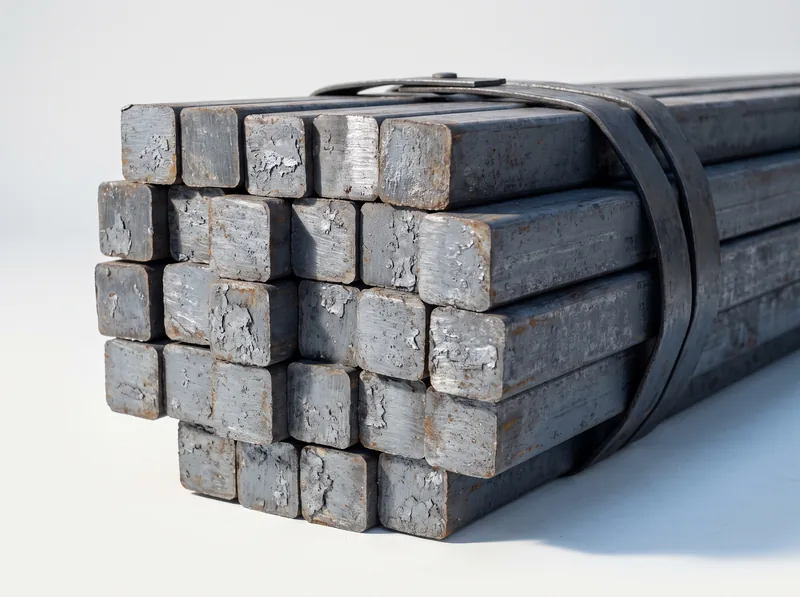
St3 · 20 · 45 · a 10–200 · GOST 2591
Hot-rolled square bar
Square bar with a side of 10–200 mm in St3, 20 and 45 to GOST 2591; equivalents Q235B, 20#, 45#
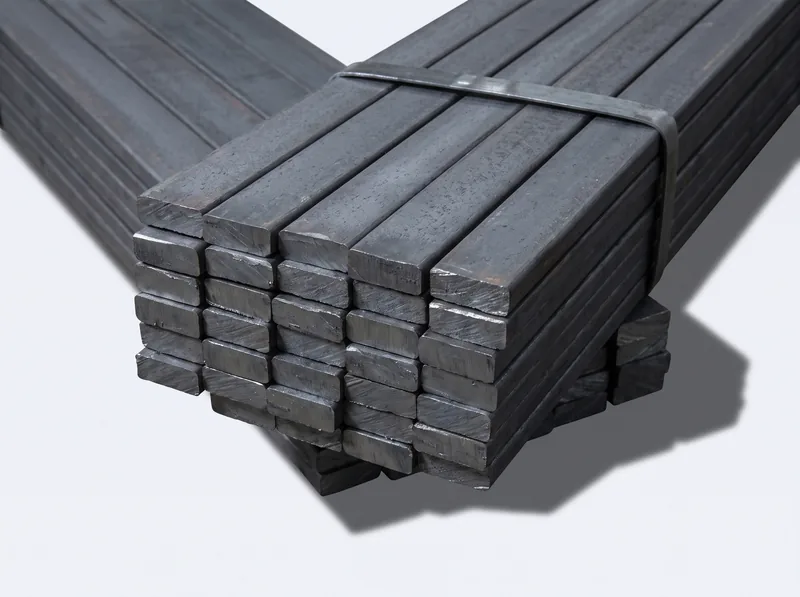
St3 · 09G2S · 20×4–200×40 · GOST 103
Flat bar of rectangular cross-section 20×4–200×40 mm in St3 and 09G2S to GOST 103; equivalents Q235B and Q355B
Pick a size in the table: each row has a quantity field in tonnes and an “Add to specification” button. Rows from several items go out as one request.
The same formula as the table below: metres to tonnes and tonnes to metres.
Formula
| Size, mm | Weight, kg/m | Add to specification |
|---|---|---|
| 20×4 | Weight, kg/m0.628 | Add to specification |
| 25×4 | Weight, kg/m0.785 | Add to specification |
| 30×4 | Weight, kg/m0.942 | Add to specification |
| 40×4 | Weight, kg/m1.26 | Add to specification |
| 40×5 | Weight, kg/m1.57 | Add to specification |
| 50×5 | Weight, kg/m1.96 | Add to specification |
| 60×6 | Weight, kg/m2.83 | Add to specification |
| 80×8 | Weight, kg/m5.02 | Add to specification |
| 100×10 | Weight, kg/m7.85 | Add to specification |
| 120×10 | Weight, kg/m9.42 | Add to specification |
| 150×12 | Weight, kg/m14.1 | Add to specification |
| 200×20 | Weight, kg/m31.4 | Add to specification |
Flat bar mass per metre is 0.00785·b·t, where b is the width and t the thickness in mm.
Theoretical weight at steel density 7.85 g/cm³. Actual batch weight is by scale and mill certificate.
Flat bar is a hot-rolled product of rectangular cross-section defined by width and thickness. Dimensions and tolerances are specified by GOST 103-2006: width from 20 to 200 mm, thickness from 4 to 40 mm within the bureau's supply range; mills in China roll flat bar to GB/T 702-2017. Rolling accuracy under GOST 103 is set separately for thickness — BT1–BT3 raised, VT1–VT3 ordinary — and for width — BSh1–BSh3 and VSh1–VSh3; camber and squareness of edges are specified by the standard separately.
The main grade is St3sp and St3ps to GOST 535: flat bar for welded structures, cover plates, clamps, earthing and forging, equivalent Q235B. For loaded joints and service at low temperatures 09G2S to GOST 19281 is taken — a low-alloy steel with a specified impact toughness at minus 40 °C, nearest equivalent Q355B. Flat bar is rolled on bar mills from billet; it differs from slit strip in that the edges are produced by rolling rather than by slitting a coil.
During inspection at the mill the bureau measures the thickness with a micrometer and the width with a calliper at several points along the bar, checks camber on a surface plate and the squareness of edges. The heat number on the tag is checked against the mill test certificate (MTC) and the chemical composition in the specification; for 09G2S the impact test results are checked. Surface — free of scabs, laps and edge tears; marking on the bundle ends and strapping are recorded in the inspection report with photographs before shipment.
Bundles strapped with steel band at several points, mill tag with grade, heat, size and weight.
Equivalents are the nearest, not identical: the exact grade and standard are written into the contract.
| GOST | GB (China) | ASTM | EN | Note |
|---|---|---|---|---|
| St3sp | GB (China)Q235B | ASTMA36 | ENS235JR | NoteNearest equivalents: carbon, manganese and impact toughness limits differ between the standards. The specification fixes the GOST grade and the control values. |
| Steel 20 | GB (China)20# | ASTM1020 | ENC22E | NoteQuality carbon steel; the equivalents match in carbon content, impurity limits are checked against the certificate. |
| Steel 45 | GB (China)45# | ASTM1045 | ENC45E | NoteSteel for heat treatment; hardness and delivery condition are checked — hot-rolled, normalised or annealed. |
| 40Kh | GB (China)40Cr | ASTM5140 | EN41Cr4 | NoteChromium alloy steel; the equivalents are close in composition, chromium content is confirmed by the heat certificate. |
| 09G2S | GB (China)Q355B | ASTMA572 Gr. 50 | ENS355JR | NoteNearest equivalents by strength; 09G2S specifies impact toughness at minus 40 °C, the equivalents use other test temperatures. |
| St1kp | GB (China)Q195 | ASTM1008 | EN— | NoteWire rod for drawing and tying wire; the nearest equivalent by carbon content, there is no single EN grade for this class. |
| 08Kh18N10 | GB (China)06Cr19Ni10 | ASTM304 | EN1.4301 | NoteAustenitic chromium-nickel steel; nearest equivalents: chromium and nickel ranges differ between the standards, composition is confirmed by the heat certificate. |
| 12Kh18N10T | GB (China)06Cr18Ni11Ti | ASTM321 | EN1.4541 | NoteTitanium-stabilised; nearest equivalents: the upper carbon limit is 0.12 % for 12Kh18N10T and 0.08 % for 321 and 1.4541; titanium content is checked against the certificate. |
| 03Kh17N14M3 | GB (China)022Cr17Ni12Mo2 | ASTM316L | EN1.4404 | NoteMolybdenum-bearing, low-carbon; nearest equivalents: the lower nickel limit of 03Kh17N14M3 is higher than that of 316L, composition is confirmed by the heat certificate. |
Equivalents are the closest match, not identical: chemistry and tolerances differ between standards. The exact grade and standard are written into the contract.
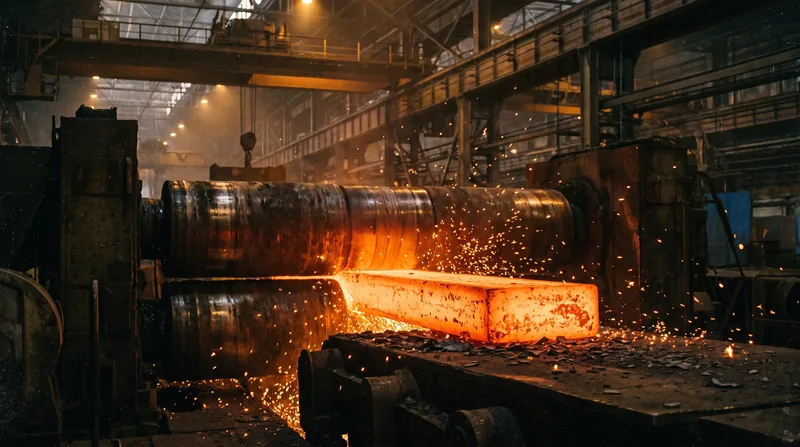
The batch is checked against the order at the mill before shipment: sizes, markings, heat numbers on the certificate and tags, packing
Documents
01
Heat number, chemical composition, mechanical properties and standard for every heat in the batch.
02
Measurements, markings, packing, weighing and bundle numbers, drawn up at the mill before shipment.
03
Items, sizes, quantities and mass by bundle: what the warehouse acceptance is checked against.
04
Confirms the mill and country of manufacture for customs clearance.
St3 · 20 · 45 · a 10–200 · GOST 2591
Square bar with a side of 10–200 mm in St3, 20 and 45 to GOST 2591; equivalents Q235B, 20#, 45#
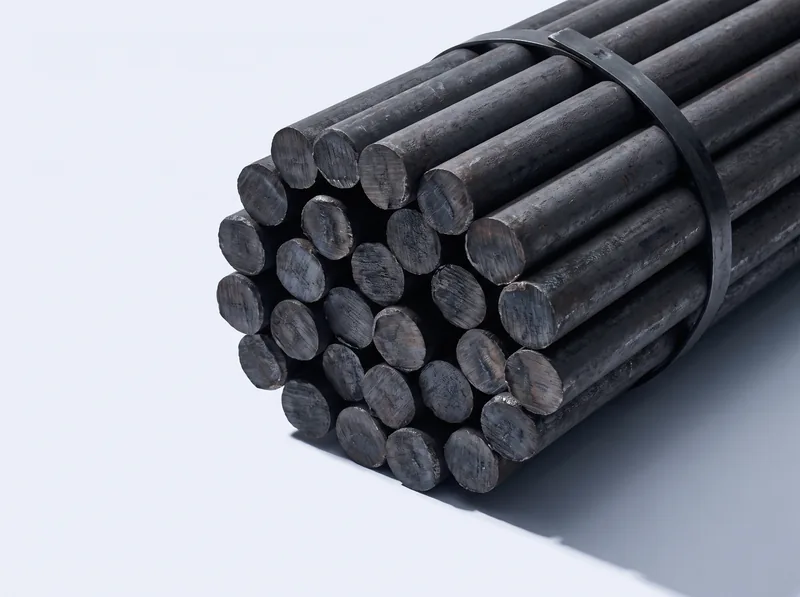
St3 · 20 · 45 · 40Kh · Ø10–300 · GOST 2590
Round bar Ø10–300 mm in St3, 20, 45 and 40Kh to GOST 2590; equivalents Q235B, 20#, 45#, 40Cr
Price request
Price depends on grade, size, tonnage and delivery terms on the day of contract.
Request received
This site keeps only your chosen language, the specification list, your sound choice and a note of this notice in your browser. There are no third-party counters or advertising cookies. Cookies