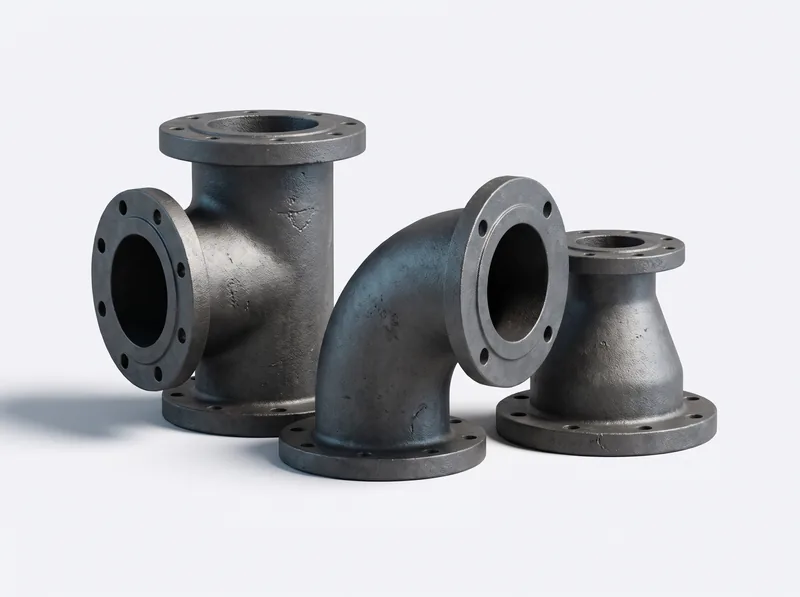
ductile iron · DN80–DN1200 · K12 · socket T / flange PN10–PN25 · EN 545
Ductile iron fittings
Bends, tees, reducers, collars and flanged pieces in class K12 for T-type sockets and PN10–PN25 flanges
ductile iron · DN80–DN1200 · K9 / C40 · 6 m · ISO 2531 · EN 545
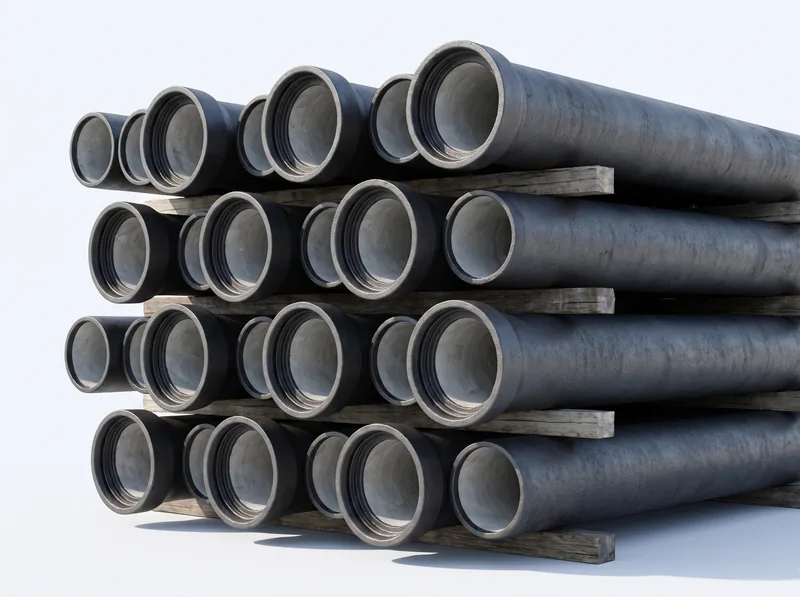
Centrifugally cast socket pipe K9 and C40 with cement mortar lining, DN80–DN1200, 6 m long
Dimensions and barrel weight of class K9 pipe without socket
| DN | Outside diameter DE, mm | Wall e, mm | Barrel weight, kg/m |
|---|---|---|---|
| 80 | Outside diameter DE, mm98 | Wall e, mm6.0 | Barrel weight, kg/m12.2 |
| 100 | Outside diameter DE, mm118 | Wall e, mm6.0 | Barrel weight, kg/m14.9 |
| 150 | Outside diameter DE, mm170 | Wall e, mm6.0 | Barrel weight, kg/m21.8 |
| 200 | Outside diameter DE, mm222 | Wall e, mm6.3 | Barrel weight, kg/m30.1 |
| 250 | Outside diameter DE, mm274 | Wall e, mm6.8 | Barrel weight, kg/m40.2 |
| 300 | Outside diameter DE, mm326 | Wall e, mm7.2 | Barrel weight, kg/m50.8 |
| 350 | Outside diameter DE, mm378 | Wall e, mm7.7 | Barrel weight, kg/m63.1 |
| 400 | Outside diameter DE, mm429 | Wall e, mm8.1 | Barrel weight, kg/m75.5 |
| 450 | Outside diameter DE, mm480 | Wall e, mm8.6 | Barrel weight, kg/m89.8 |
| 500 | Outside diameter DE, mm532 | Wall e, mm9.0 | Barrel weight, kg/m104.3 |
| 600 | Outside diameter DE, mm635 | Wall e, mm9.9 | Barrel weight, kg/m137.1 |
| 700 | Outside diameter DE, mm738 | Wall e, mm10.8 | Barrel weight, kg/m174.0 |
| 800 | Outside diameter DE, mm842 | Wall e, mm11.7 | Barrel weight, kg/m215.2 |
| 900 | Outside diameter DE, mm945 | Wall e, mm12.6 | Barrel weight, kg/m260.2 |
| 1000 | Outside diameter DE, mm1048 | Wall e, mm13.5 | Barrel weight, kg/m309.3 |
| 1200 | Outside diameter DE, mm1255 | Wall e, mm15.3 | Barrel weight, kg/m420.1 |
Sizes and masses follow the tables of the standard named in the table heading; rows that cannot be verified are not listed.
Theoretical weight at steel density 7.85 g/cm³. Actual batch weight is by scale and mill certificate.
Pressure pipe in ductile (spheroidal graphite) iron for water supply and sewerage: a socket for a rubber gasket at one end, a spigot at the other. The pipe is cast centrifugally — after magnesium treatment the liquid iron is poured into a rotating water-cooled mould, and centrifugal force forms a dense wall of constant thickness. After casting the pipe is annealed to a ferritic structure: tensile strength not less than 420 MPa, elongation not less than 10 % for DN up to 1000 and not less than 7 % for DN above 1000, hardness not more than 230 HB.
Wall thickness is set by class. K9 follows the formula e = 9·(0.5 + 0.001·DN), not less than 6 mm: 6.0 mm for DN100, 7.2 mm for DN300, 9.9 mm for DN600. Classes C25, C30 and C40 to EN 545:2010 and ISO 2531:2009 are defined by the allowable operating pressure in bar, and at the same DN the wall comes out thinner than K9. Inside — a centrifugally applied cement mortar lining to ISO 4179; outside — metallic zinc not less than 200 g/m² and bituminous varnish; for sewer networks to EN 598 the lining is made of high-alumina cement. The joint is a T-type (Tyton) socket with an EPDM gasket. Every pipe passes a works hydrostatic test: for K9 this is 5.0 MPa at DN80–DN300, 4.0 MPa at DN350–DN600, 3.2 MPa at DN700–DN1000, 2.5 MPa at DN1100–DN1200.
During inspection at the plant the bureau measures the spigot outside diameter with a circumferential tape, wall thickness at the end face with a calliper, thickness along the barrel with an ultrasonic thickness gauge, cement lining thickness at control points; checks the socket and sealing groove, the cast marking — plant mark, DN, class, year — and matches the heat number on the pipe with the plant's mill test certificate (MTC): heat chemistry, mechanical properties, hydrostatic test result. The full set of gaskets and lubricant and the stacking of pipes on bearers before loading are checked separately.
Pipes are stacked on timber bearers with sockets alternating in opposite directions; DN80–DN300 in strapped bundles. Sealing gaskets and lubricant are packed separately in bags tagged by DN and batch number.
Equivalents are the nearest, not identical: the exact grade and standard are written into the contract.
| GOST | GB (China) | ASTM | EN | Note |
|---|---|---|---|---|
| VCh45 (GOST 7293-85) | GB (China)QT450-10 (GB/T 1348) | ASTM65-45-12 (ASTM A536) | ENEN-GJS-450-10 (EN 1563) | NoteNearest equivalents by strength and elongation. Pipe standards specify mechanical properties directly; the casting grade in the plant certificate is for reference. |
| K9 (GOST ISO 2531-2012) | GB (China)K9 (GB/T 13295) | ASTM— | ENK9 (EN 545:2006) | NoteWall thickness class: e = 9·(0.5 + 0.001·DN), not less than 6 mm. In the ISO 2531:2009 and EN 545:2010 editions pressure classification became the primary one, K9 is retained for continuity. AWWA C151 classifies by pressure; the thicknesses do not match. |
| C40 (GOST ISO 2531-2012) | GB (China)C40 (GB/T 13295-2019) | ASTM— | ENC40 (EN 545:2010) | NoteClass by allowable operating pressure of 40 bar. At the same DN the C40 wall is thinner than K9; the classes are not equated — the specification names one class and one edition of the standard. |
| Socket with rubber ring (GOST ISO 2531-2012) | GB (China)Socket T-type (GB/T 13295) | ASTMPush-on (AWWA C111/A21.11) | ENTyton / push-on (EN 545) | NoteTyton is a trade name of the joint. Socket seating dimensions are set by the standard, but the groove and gasket profile differs between plants: gaskets are ordered from the pipe manufacturer. |
| — | GB (China)GB/T 21873 | ASTM— | ENEN 681-1 / ISO 4633 | NoteEPDM sealing gaskets for drinking water. Gasket requirements are checked against EN 681-1 and ISO 4633, which GOST ISO 2531-2012 references. |
| — | GB (China)GB/T 17457 | ASTMAWWA C104/A21.4 | ENISO 4179 / EN 545 | NoteCement mortar lining. Nominal thickness to ISO 4179: 3 mm for DN80–DN300, 5 mm for DN350–DN600, 6 mm for DN700–DN1200. |
| GOST 33259-2015 (PN10, PN16) | GB (China)GB/T 17241.6 | ASTMASME B16.1 (Class 125) | ENEN 1092-2 (PN10, PN16, PN25) | NoteFlange connection dimensions PN10 and PN16 to EN 1092-2 and GOST 33259 coincide for most DN and are checked against the drawing. ASME B16.1 has a different bolt-hole pattern and does not mate with EN flanges. |
Equivalents are the closest match, not identical: chemistry and tolerances differ between standards. The exact grade and standard are written into the contract.
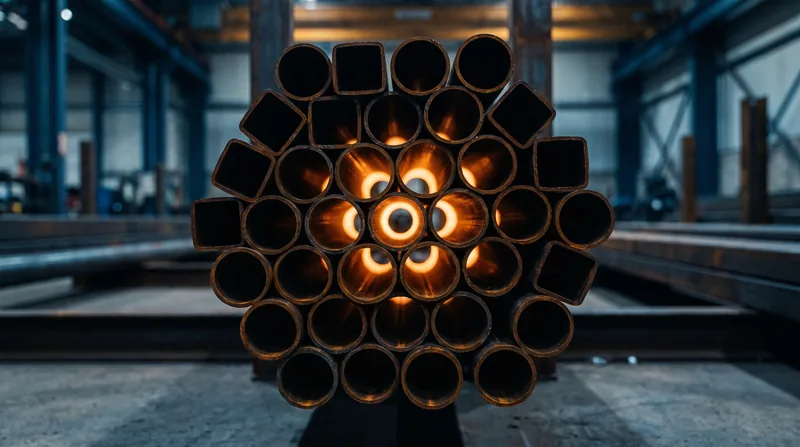
The batch is checked against the order at the mill before shipment: sizes, markings, heat numbers on the certificate and tags, packing
Documents
01
Heat number, chemical composition, mechanical properties and standard for every heat in the batch.
02
Measurements, markings, packing, weighing and bundle numbers, drawn up at the mill before shipment.
03
Items, sizes, quantities and mass by bundle: what the warehouse acceptance is checked against.
04
Confirms the mill and country of manufacture for customs clearance.
ductile iron · DN80–DN1200 · K12 · socket T / flange PN10–PN25 · EN 545
Bends, tees, reducers, collars and flanged pieces in class K12 for T-type sockets and PN10–PN25 flanges
Price request
Price depends on grade, size, tonnage and delivery terms on the day of contract.
Request received
This site keeps only your chosen language, the specification list, your sound choice and a note of this notice in your browser. There are no third-party counters or advertising cookies. Cookies